

Overtime Premiums & Year-End Reporting

Employers must report qualifying overtime compensation beginning in 2026 as part of the “No Tax on Overtime” portion of the One Big Beautiful Bill Act).  The qualified premiums are based on FLSA overtime guidelines.

What must be reported W-2 Field 1099 Field

Total Amount of Qualifying Overtime Compensation designated by the code TT

Employers must report  the total amount of qualifying overtime compensation
for the purpose of the income tax deduction. 

Box 12

Box 1d for 1099-NEC

Box 14 for 1099-MISC

What You Need to Do

It is your responsibility as an employer to determine how overtime is calculated and ensure compliance with the Fair Labor Standards Act.  You must follow the steps below to ensure the accuracy of what is being reported on W-2s.  The deadline to request adjustments to the calculation is December 11, 2026.

STEP 1: Determine if your company is impacted.

If Box 12, Code TT appears on your employees’ 2026 W-2s, this indicates that qualifying overtime compensation is being reported under the OBBBA No Tax on Overtime provision.

To review impacted employees, go to REPORTING > YEAR END REPORTS ON DEMAND > search EMPLOYER . to find W-2 Copy D Employer.
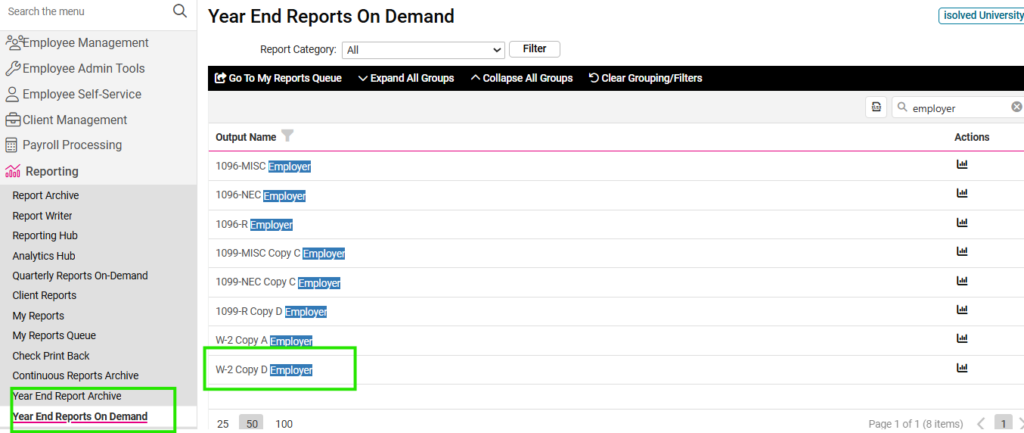
Impacted employees will have Box 12a, code TT.

Please note that this amount is also found on your PAYROLL REGISTER with each payroll processed.  During the year, some clients had asked us to hide the code on the report – if you have OT and do NOT see it on your PAYROLL REGISTER, you can email [email protected] to unhide the code.  It has ZERO impact to the actual payroll being processed – it is strictly a W2 reporting item.

STEP 2: Confirm your overtime calculations are FLSA Compliant

Employers are responsible for ensuring their overtime policies and calculations comply with the Fair Labor Standards Act (FLSA). If you are uncertain, please consult your accountant, employment attorney, or HR consultant.

STEP 3: Review your W-2 reporting and notify PremierNow by 12/11/2026 if you need adjustments

PremierNow’s system is configured based on isolved’s standard calculation and guidance from its legal advisors. If you believe the calculated qualifying overtime amount needs to be adjusted, please notify PremierNow no later than December 11, 2026 so any necessary adjustments can be processed before year-end.

Upon request, we can provide a report showing employees’ year-to-date overtime earnings. You would then be responsible for reviewing those earnings, calculating any necessary adjustments, and providing PremierNow with the corrected amounts to override the system-generated figures.

Consider the employee impact before requesting changes. The No Tax on Overtime provision is a federal income tax deduction, and the actual benefit varies based on each employee’s income, filing status, and eligibility. We encourage employers to consider the potential tax benefit relative to the administrative effort involved, while ensuring all required reporting remains accurate.

Note: Changes requested after year-end processing is complete and W-2s have been generated may require Forms W-2c and will result in additional correction fees.

What PremierNow & isolved are doing to help:
  • We have configured our payroll system based on guidance provided by isolved and its legal advisors to support the new OBBBA reporting requirements.
  • PremierNow will rely on the overtime earnings and configurations provided or approved by the employer.
What we don’t do:
  • PremierNow does not establish or validate your company’s overtime policies.
  • We will not independently audit or verify that the underlying calculations for comply with federal or state wage and hour laws.

If you are uncertain whether your current overtime practices are FLSA-compliant or how your overtime earnings should be classified for purposes of this deduction, we recommend consulting your accountant, employment attorney, or qualified HR consultant.

Background on Overtime Premium under OBBBA

The Overtime Premium deduction typically covers the difference between regular and overtime pay.

Example: An employee earns $25 per hour and works five overtime hours per week.

  • Regular hourly rate: $25
  • Overtime hourly rate: $37.50
  • Qualifying overtime premium: $12.50 per overtime hour
  • Annual qualifying overtime premium (52 weeks): $3,250

If the employee falls within the 22% federal income tax bracket, that could result in approximately $715 in annual federal income tax savings.

FAQs

Only the additional overtime premium required under federal law qualifies—not the entire overtime payment.  See above for calculation of Overtime Premium.

Here’s an example:

An employee earns $25 per hour and works five overtime hours per week.

  • Regular hourly rate: $25
  • Overtime hourly rate: $37.50
  • Qualifying overtime premium: $12.50 per overtime hour
  • Annual qualifying overtime premium (52 weeks): $3,250

If the employee falls within the 22% federal income tax bracket, that could result in approximately $715 in annual federal income tax savings.

The deduction begins to phase out when annual modified adjusted gross income exceeds $150,000 for single filers or $300,000 for married couples filing jointly.

The maximum annual deduction is $12,500 for individual filers and $25,000 for joint filers.

Not automatically. Overtime continues to be subject to regular payroll tax withholding, including Social Security and Medicare. Eligible employees generally claim the federal income tax deduction when filing their personal income tax returns.

Employees who regularly work qualifying overtime may see meaningful federal income tax savings, even if they earn only a few thousand dollars in overtime premiums throughout the year.

Actual tax savings depend on individual income, filing status, eligibility, and other tax circumstances.

Important Reminder: PremierNow will rely on the overtime earnings, calculations, and configurations provided or approved by the employer. We do not independently audit or verify overtime calculations for FLSA compliance. Responsibility for determining qualifying overtime and ensuring the accuracy of employer-provided information remains with the employer.

Deadline to request adjustments: December 11, 2026.

Changes requested after year-end processing is complete and W-2s have been generated may require Forms W-2c and will result in additional correction fees.

Scroll to Top